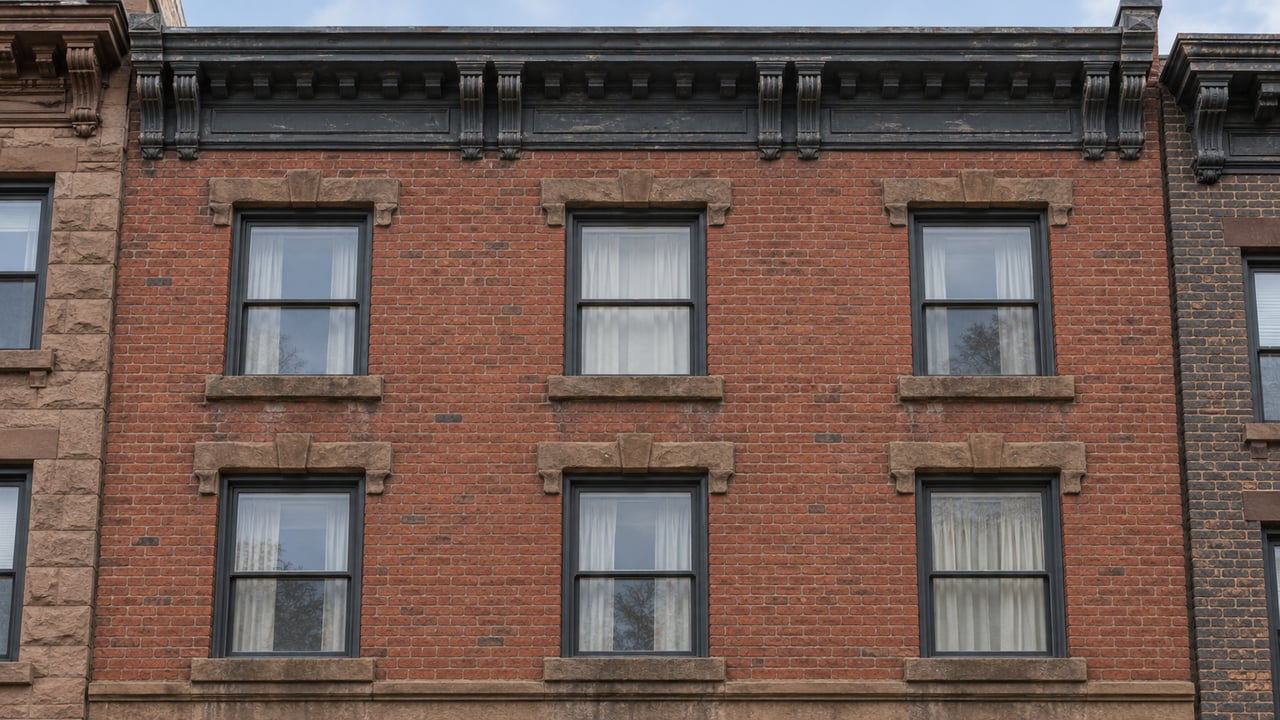
On April 16, 2026, a three-unit building at 645 DeKalb Avenue sold for $1,700,000, or about $566,667 per apartment and $756 per square foot. Four weeks later, on May 13, an eight-unit building at 323 Malcolm X Boulevard sold for $1,400,000. That works out to $175,000 per apartment and $156 per square foot. Both sit in the same part of Brooklyn and appear in the same quarterly sales log. Per square foot, one sold for nearly five times the price of the other.
The listing photos and the median price on a portal won't explain that gap. The explanation starts with a count. In New York City, the number of apartments in a building decides which rulebook may apply to it, and the number of apartments its owner holds statewide decides a second one. In 2026 both counts are carrying more weight than usual.
The line is drawn by count
New York State Homes and Community Renewal describes the general rule plainly. In New York City, rent stabilization applies to buildings of six or more units built between February 1, 1947 and December 31, 1973. Tenants in buildings built before February 1, 1947 who moved in after June 30, 1971 are also covered. Much of Bed-Stuy's brownstone and walk-up stock went up before 1947, so for these buildings the first question is usually whether there are at least six units.
A building with five apartments is not automatically outside the system. HCR's overview adds a third category: buildings with three or more apartments built or extensively renovated on or after January 1, 1974 that receive special tax benefits. Those buildings are generally stabilized only while the benefits continue or, in some cases, until the tenant moves out. HCR's Fact Sheet #1 names J-51, 421-a and 421-g as programs that can bring apartments under stabilization, each with its own rules.
So a building's regulatory status is tied to its unit count and its tax history, and neither one shows in the façade.
What changed on October 1
On June 25, 2026, the Rent Guidelines Board adopted a 0% adjustment for both one-year and two-year renewals of stabilized leases that begin between October 1, 2026 and September 30, 2027. Gothamist reported that the vote was 7 to 1, that it was the first two-year freeze in the board's history, and that it covers about one million apartments. The outlet also noted that Mayor Zohran Mamdani named six of the board's nine members. In the same article, Gothamist quoted Real Estate Board of New York President James Whelan saying the board "ignored its own data and made a terrible decision tonight."
For a stabilized apartment, renewal income stays flat through at least September 2027. For an unregulated apartment in a small building, the freeze doesn't apply at all. Two buildings on the same block can end up on different income paths because of a single apartment.
The gap was already in the sales data
The freeze added to a split that was already showing in the numbers. Ariel Property Advisors' Q2 2026 citywide review found that small multifamily buildings, those below six units, held steady at $372.2 million in sales, up 3% year over year. The six-to-nine-unit segment fell 42% to $149.6 million. In Brooklyn, the firm's first-half 2026 report showed the 10-plus-unit segment down 30% to $850 million. Smaller assets rose 16% to $410.1 million, and the report noted that local owner-operators stayed active in sub-six-unit buildings.
The Q2 2026 transaction log for Bed-Stuy and Crown Heights shows the same split one address at a time. It is the most recent neighborhood-level breakdown available, and it covers April through June.
| Address | Sale date, 2026 | Price | Segment | Per unit | Per sq ft |
|---|---|---|---|---|---|
| 62 Tompkins Ave | May 11 | $3,500,000 | Under 6 units | $875,000 | $500 |
| 724 Myrtle Ave | June 9 | $3,050,000 | Under 6 units | $762,500 | $813 |
| 645 DeKalb Ave | April 16 | $1,700,000 | Under 6 units | $566,667 | $756 |
| 346 Malcolm X Blvd | April 1 | $1,625,000 | Under 6 units | $541,667 | $645 |
| 670 Halsey St | June 17 | $3,525,000 | 6 to 9 units | $503,571 | $704 |
| 1355 Pacific St | April 14 | $1,832,102 | 6 to 9 units | $229,013 | $210 |
| 323 Malcolm X Blvd | May 13 | $1,400,000 | 6 to 9 units | $175,000 | $156 |
| 328 Madison St | April 30 | $1,200,000 | 6 to 9 units | $150,000 | $158 |
The log does not record each building's stabilization status, and ground-floor retail can push per-unit figures up. These sales show a pattern but do not prove a cause. One row matters for reading the rest, though. 670 Halsey Street, a seven-unit building, sold at $704 per square foot, close to the small-building prices. In the same quarter, Ariel's citywide review observed that pricing tracks rent levels. Lower-rent product reset at lower valuations, and buildings with higher in-place rents commanded a meaningful premium. The sixth unit decides whether the rent roll could be regulated, and the rent roll sets the price.
Why the freeze widens the spread
The mechanism comes down to expenses. In its Q2 2026 watchlist, Ariel put operating-expense growth at roughly 40% over five years. Cumulative allowed rent growth over the same period was 16%. The firm also pointed to 2021-vintage loans coming due at roughly double their original rates. Citywide, rent-stabilized buildings averaged about $149,000 per unit in Q2 2026, 43% below the 2019 level. Most of that decline came before the June vote.
Financing pushes in the same direction. In a July 15, 2026 analysis, Fitch Ratings said lenders were likely to underwrite stabilized income conservatively, with higher debt-service coverage requirements and lower loan-to-value ratios. A smaller loan on the same income means a buyer needs more cash, which narrows the pool of buyers on the regulated side of the line.
The newest figures, from Ariel's Q3 2026 report released October 16, cover only buildings of ten or more units, but the spread is plain. In Brooklyn, buildings that were 75% or more free-market averaged $509,000 per unit in Q3. Buildings that were 75% or more rent-stabilized averaged $134,000. Free-market buildings made up 86.3% of Brooklyn's $693.8 million in Q3 multifamily dollar volume. The same report flags tax abatements expiring on about 4,100 buildings and 66,000 units through 2030, with higher property taxes to follow. For a small Bed-Stuy building that is stabilized because of a tax benefit, the date that benefit ends belongs in the underwriting.
A second line, at ten, counts the owner
The six-unit line looks at the building. New York's Good Cause Eviction law, in effect since April 20, 2024, looks at the owner. According to NYC HPD's guidance, the law gives some tenants of unregulated, market-rate homes new protections against having a tenancy ended without a "good cause" reason.
State law defines a "small landlord" in New York City as one with no more than 10 units statewide. When the owner is an entity, each person with a direct or indirect stake must meet that cap, as Real Property Law §211 sets out. Section 214 separately excludes an owner-occupied building of no more than 10 units, even if the owner holds more units elsewhere. It also excludes, among other categories, most buildings whose certificates of occupancy were issued on or after January 1, 2009, for 30 years. HCR's August 2026 notice updated the annual figures, including an 8.38% local rent standard, and kept the 10-unit test.
This matters to someone who already owns a few units. A four-family purchase can carry an investor holding eight apartments past the ten-unit line, and the same building may then fall under a different set of rules than it did for its seller. The building has not changed, but its new owner's portfolio has.
Questions a unit count raises before contract
Each of these questions has an answer on file somewhere, and each one bears on what a Bed-Stuy building is worth to a particular buyer:
- How many legal residential units the building has, and when it was built or substantially renovated
- Whether the owner files annual building registrations with HCR's Office of Rent Administration, which HCR requires of stabilized buildings
- Whether the building has ever received J-51, 421-a or another tax benefit, and when that benefit ends
- How many units the buyer, and each person behind the buyer's entity, will hold statewide after closing
This post is general information about published rules and market data, not legal, tax or financial advice. Confirm how these rules apply to a specific building or ownership structure with an attorney, accountant or lender.
FAQ
Does the 2026 freeze apply to a three-family brownstone? Under HCR's general rule, a pre-1974 building needs six or more units for standard stabilization. A post-1974 building with three or more apartments can be stabilized while it receives certain tax benefits, so a small building's history still needs checking.
How long does the freeze last? The 0% guideline covers stabilized one- and two-year renewals that begin from October 1, 2026 through September 30, 2027. Because two-year leases are included, a two-year renewal commencing in that window keeps its rent flat into 2029.
Do Good Cause Eviction and rent stabilization overlap? No. The law excludes rent-regulated housing. It also excludes several categories of unregulated housing, including certain owner-occupied buildings and most buildings with certificates of occupancy issued on or after January 1, 2009, so an apartment can fall under neither framework.
If you own a two-to-nine-unit building in Bed-Stuy, its unit count, tax history and rent roll now shape its price more than they did a year ago. MINSKY | ABRISHAMI prepares valuations that start with those three things. Request a Free Home Valuation, and we will show you which side of each line your building sits on and what that means for its price.