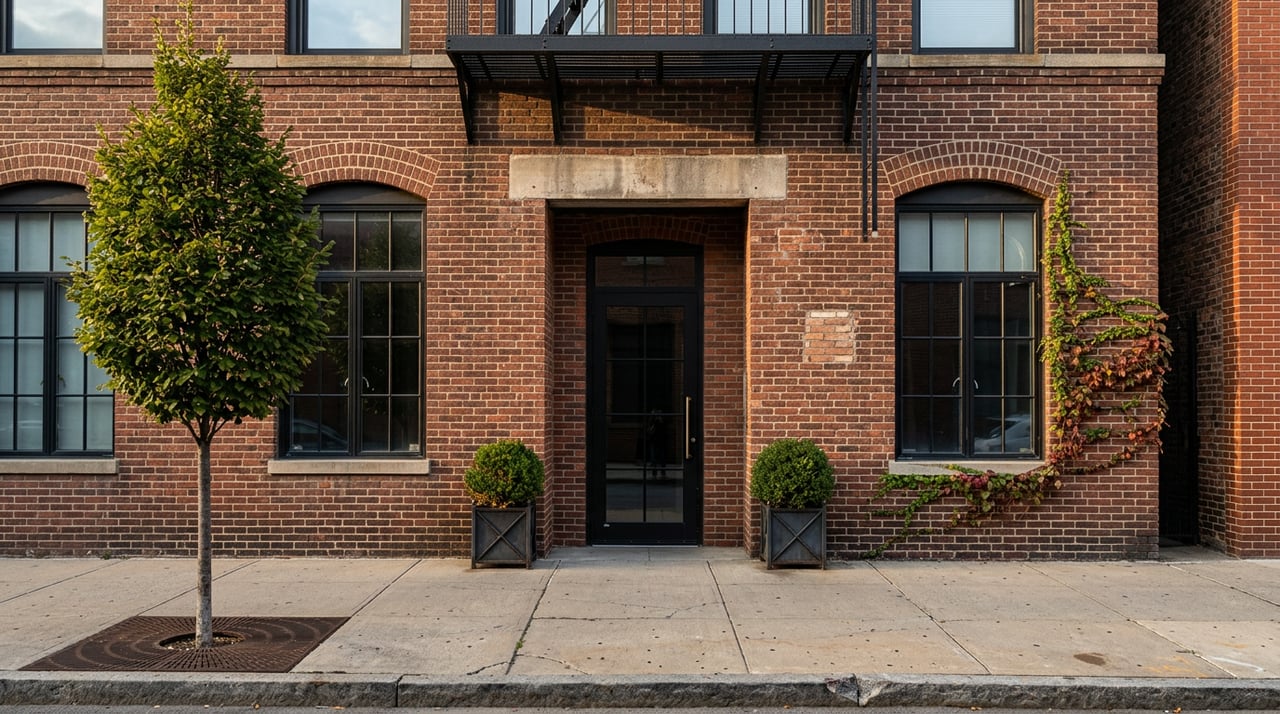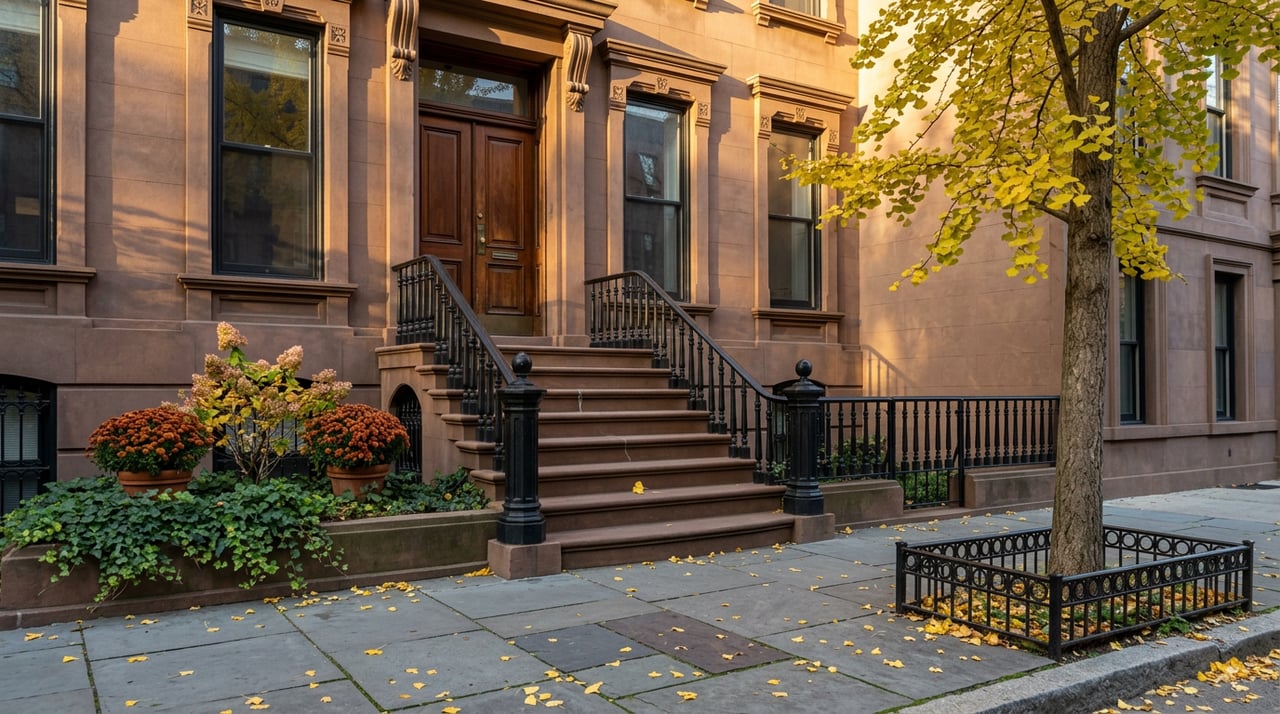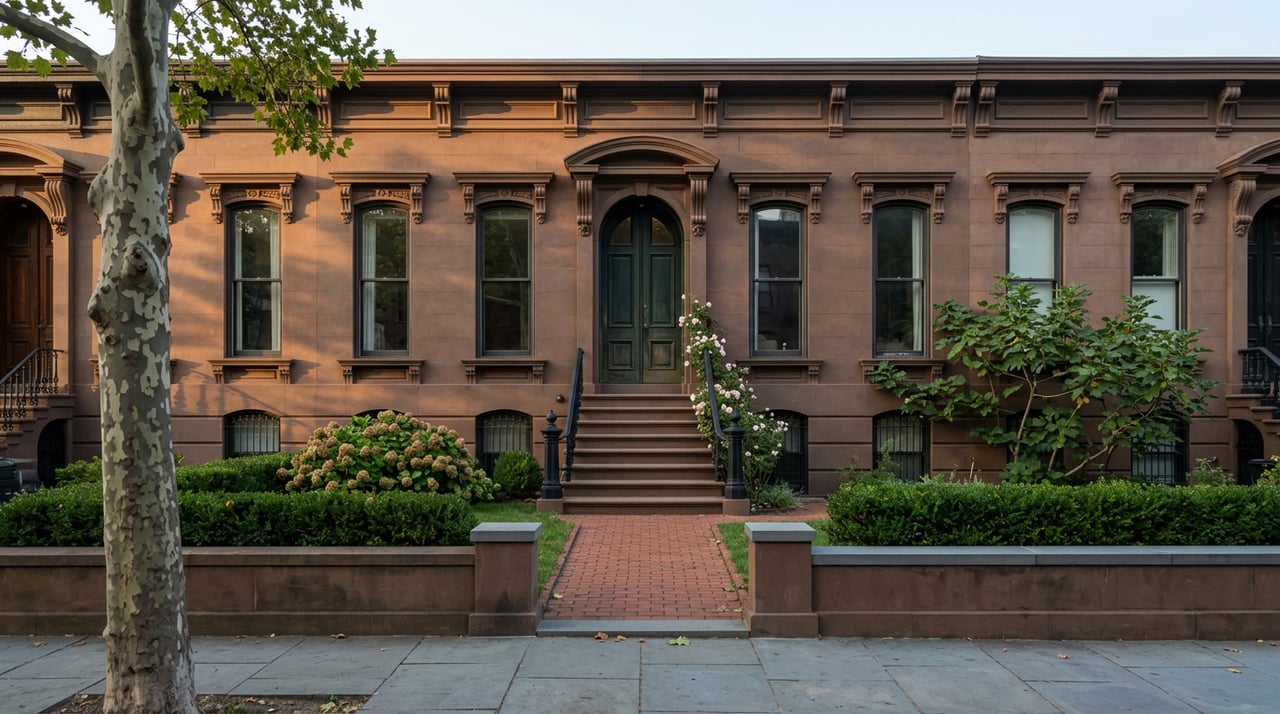
Walk down Carroll Street between Smith and Hoyt on a mid-August evening and the block does something no other stretch of brownstone Brooklyn quite manages. The houses sit back far enough that you could park a second row house in the gap between the stoop and the sidewalk. Fig trees lean over wrought iron fences, their branches heavy with fruit that will not be ready for another few weeks. A Madonna statue watches from behind a screen of hydrangea that has gone from blue to a papery bronze now that the season has turned past its peak. Most people who live here know this look is the neighborhood's signature. Fewer know it was written into law in 1846, or that the law only ever applied to a handful of blocks, not the whole neighborhood that now borrows its name.
A Law, Not a Preference
The deep front yard that gave Carroll Gardens its name was not a builder's flourish or a marketing idea. In 1846, a surveyor named Richard Butts drew up a street plan for the area and attached a legal requirement to it: buildings between Henry Street and Smith Street had to sit 33 feet 5 and a quarter inches back from the property line, leaving a fixed strip of ground in front of every house. That specific measurement, down to the quarter inch, is what the city's Landmarks Preservation Commission cited when it designated the Carroll Gardens Historic District in 1973, covering the President Street and Carroll Street blocks between Smith and Hoyt Streets. The district holds well over a hundred rowhouses, mostly Italianate and Neo-Grec brownstones built between the 1860s and 1880s, and every one of them was built to honor Butts's original setback.
That is a real estate footnote most residents never hear, but it explains something concrete about the block you're standing on. The yard is not a lawn or a garden by accident. It is a legal easement that has outlived the government that imposed it.
Where the Rule Actually Ends
Here is the part that gets flattened every time the neighborhood gets described in a single sentence. The 33-foot rule applied to a specific corridor: Henry to Smith, running through First to Fourth Place, President Street, and Carroll Street. It never touched Court Street, one block to the west, or the commercial stretch of Smith Street itself, both of which grew up as tight-to-the-sidewalk shopping corridors serving the same working-class residents who lived behind those deep yards. Walk from Carroll Street onto Court and the setback disappears within a single block. The storefronts that now house Court Street Grocers and the string of butcher shops and bakeries along that corridor were never subject to Butts's plan, because they were built to serve foot traffic, not to hold a garden.
This matters for how you actually experience the neighborhood day to day. "Carroll Gardens" gets used loosely to describe everything from the historic district to the Columbia Street waterfront blocks a few streets over, but the deep yards, the actual physical feature the name refers to, live on a tight cluster of blocks. If you want to see the real thing rather than the general impression of it, First through Fourth Place and the landmarked stretch of President and Carroll between Smith and Hoyt are where the law actually did its work.
What's Sitting in the Ground Right Now
Mid-August is a specific moment for these yards. The spring bulbs are long gone and the roses that lined the fences in June are past their first flush. What is left standing this time of year tells you something about who has tended these gardens for generations. Fig trees, an Italian-American planting tradition that goes back to the neighborhood's late-19th-century immigrant families, are heavy but not yet ready, usually another few weeks from harvest. Hydrangea has moved into its late-summer color, less showy than earlier in the season but still doing the work of filling the yard. The Madonna statuary tucked among the plantings on some of these blocks is not decoration borrowed from a catalog. It is a continuation of the same devotional gardening that has marked these yards since the neighborhood's Italian population settled in behind the docks and the Navy Yard.
None of this required city permission to exist. It required the space Butts's plan set aside, and generations of families who kept using it the same way.
The Same Instinct, Three Blocks West
What is easy to miss is that the private front yard was not the only place this impulse showed up. A few blocks west, in the Columbia Street Waterfront strip that borders Carroll Gardens but sits outside the historic district and outside Butts's original footprint, residents did the same thing on public and leftover land instead of private lots. The Summit Street Community Garden, a 4,753-square-foot plot maintained by NYC Parks' GreenThumb program, sits near the corner of Summit and Hicks and keeps regular weekend hours from April through October, open Saturdays and Sundays from 11 a.m. to 4 p.m. A few blocks away, the Amazing Garden at Carroll and Columbia Streets holds 17 shared beds tended by neighborhood volunteers, hosts school field trips, and uses the blank whitewashed wall of an adjoining building as a screen for outdoor film nights. Nearby still is the Human Compass Garden at Sackett and Columbia, one of the earliest of the area's community gardens.
None of these gardens exist because of the 1846 law. They exist because the same neighborhood habit, the instinct to claim a patch of ground and plant something in it, kept showing up wherever there was room, whether that room came from a legal easement on a brownstone lot or a vacant parcel three blocks from the water. The private yards and the public gardens are not the same institution, but they are the same impulse, expressed a century and a half apart on either side of a street the original plan never crossed.
Carroll Park as the Shared Front Yard
For residents whose own front yard is a narrow strip behind a fence, Carroll Park does the heavier lifting. It is Brooklyn's third-oldest park, dating to 1867, predating most of the rowhouses that now surround it. It functions less like a neutral green space and more like the block's shared yard, the place where the deep private gardens spill out into something communal. Smith Street Stage has used the park's open square for its Shakespeare in Carroll Park series, staging productions like Much Ado About Nothing and Julius Caesar in the same square where kids play and dog walkers cut through on their evening loop.
If you want to see how the neighborhood's original garden law and its later, unofficial garden culture sit next to each other in real time, a single weekend walk covers it. Start on Carroll or President Street between Smith and Hoyt for the real, legally mandated deep yards. Cut over to Columbia Street on a Saturday or Sunday afternoon before October, when the Summit Street Community Garden is open, to see the version of the same instinct that grew up outside the law's reach. End at Carroll Park, where both traditions meet on common ground that nobody had to build a fence around.
If a walk through these blocks ever turns into a bigger question, what a garden apartment or a brownstone on one of these streets might be worth, or what it would take to find one, the MINSKY | ABRISHAMI Team knows this stretch of Brooklyn block by block. A free home valuation is available whenever you're curious, no walk required.